Care workers in disability and aged care carry one of the most cognitively demanding jobs in Australia. Before each service delivery, they need a complete picture of the participant in front of them — current care needs, active agreements, recent incidents, upcoming appointments, medication notes, goal progress, and funding status. In Maica, this information lives across eight or more related records on a participant's Salesforce profile.
For a care worker arriving at a participant's home, navigating multiple screens and piecing together that picture from unstructured notes takes time they don't have. At scale — a worker servicing multiple participants across different locations each day — the cumulative cost in time and cognitive load is significant.
Maica came to Code Zero with a clear brief: build an AI-powered summary feature that gives care workers instant, meaningful context about a participant before they walk through the door.
Code Zero's engagement spanned the full product lifecycle — from technical discovery through to packaged delivery inside Maica's existing Salesforce managed package.
Before a line of code was written, we mapped the Maica data model across all relevant Salesforce objects, defined the care worker persona, and established what data should and should not appear in an AI-generated summary. Privacy considerations were built into the architecture from the start. The feature was designed with Australian Privacy Principles in mind — participant PII never leaves Salesforce and is never included in any AI prompt.
Prompt engineering was a significant part of the work. The quality of an AI product is only as good as its prompts. We developed and evaluated prompt templates across multiple iterations using a structured quality rubric covering accuracy, completeness, clinical relevance, output format, and safety. The result is a summary that reads as a practical handover note — not a data dump — calibrated to the language and priorities of the sector.
The entire feature was built within Maica's existing managed package. It deploys alongside Maica, inherits Maica's security model, and follows Salesforce's object-level and field-level security controls. The AI call goes out to Google's Gemini API and returns a summary — nothing else leaves Salesforce. No data is stored by a third party.
Code Zero uses AI tooling throughout our development workflow. On this engagement, approximately 95% of the build was executed by AI under Code Zero's direction, architecture, and review — allowing the project to move at a pace a conventional development model couldn't match, without sacrificing code quality, test coverage, or security standards.
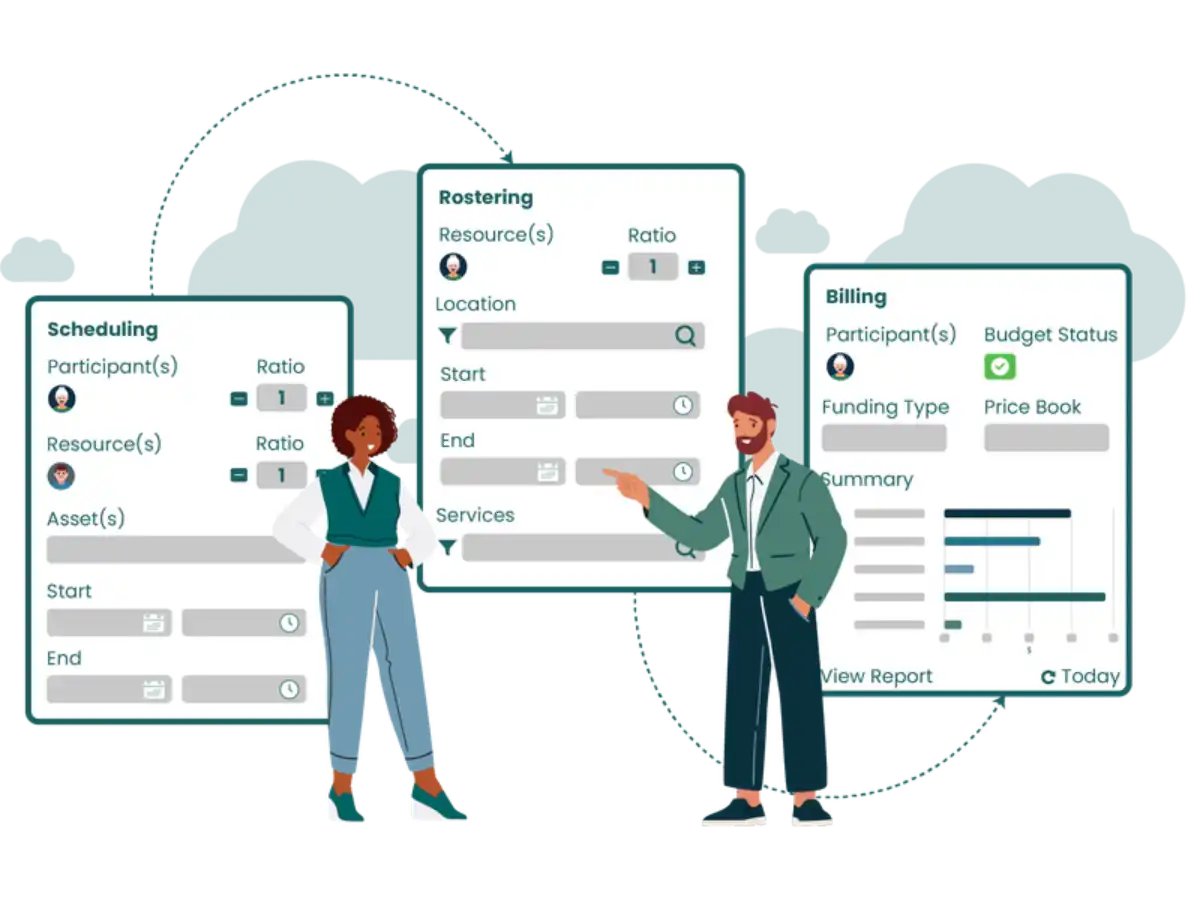
The result is Meet Me — an AI summary feature now integrated into the Maica platform.
For care workers, Meet Me auto-generates a participant summary when they open a Contact record in Salesforce. The summary draws from the participant's recent case notes, active service agreements, support items, funding position, delivery history, appointments, and goals. It renders in seconds. Workers can adjust the detail level, date range, and which data sections to include — and their preferences are remembered between sessions.
For administrators, Meet Me ships with a dedicated settings interface inside the Maica admin console. Organisations can enable the feature, configure the Gemini API connection, and — critically — extend the feature to their own custom Salesforce objects without any code changes. The platform discovers the objects, the administrator configures the fields, and the AI does the rest.
The architecture is built to last. The feature uses an LLM provider interface, meaning the underlying AI model can be swapped without rearchitecting the callout layer. Custom object support is built on Salesforce's Custom Metadata type, allowing tenant-specific configuration to be managed through standard Salesforce tooling.
The delivery of Meet Me is the beginning, not the end. Code Zero and Maica are continuing to work together to evolve the platform's AI capabilities — migrating the feature deeper into Maica's native architecture, adding coordinator and administrator summary personas, and exploring AI-assisted care documentation to reduce the administrative burden on frontline workers.
The Meet Me architecture — the data layer, the provider interface, the configurable tenant object system — was designed explicitly to serve as a foundation for future AI features on the platform. This project established both a working product and a pattern for how AI can be embedded into care management software in a way that is practical, private, and genuinely useful for the people who need it most.